Commercial Embroidery Machines Guide » Commercial Embroidery Machine Comparison Guide » Ricoma EM-1010 vs Tajima TMEZ-SC
Ricoma EM-1010 vs Tajima TMEZ-SC
Index
More
Choosing a commercial embroidery machine is not just about picking a well-known brand. For many businesses, the harder question is which machine fits the way they actually work.
A small custom apparel shop may need flexibility, simple setup, and room to grow. A shop offering in-store embroidery or recurring custom work may care more about consistency, operator support, and a smoother workflow across different materials.
Ricoma and Tajima are both considered by buyers looking for business-use embroidery machines, but they tend to fit different buying situations. This comparison looks at their differences through product direction, workflow, business scale, and use case.
Key Takeaways
- Ricoma may fit businesses starting or expanding custom embroidery services, especially when flexibility, training, and a practical growth path are important.
- Tajima may fit businesses that need stable output, professional workflow support, and consistent results across different materials.
- The better comparison is not simply brand versus brand. Buyers should look at machine configuration, operator experience, product mix, support, and future growth plans.
- For many buyers, the right choice depends less on the logo on the machine and more on what they produce, how often they produce it, and who will operate the machine.
Ricoma EM-1010 vs Tajima TMEZ-SC at a Glance
| Comparison Point | Ricoma EM-1010 | Tajima TMEZ-SC |
|---|---|---|
| Typical fit | Home creators and small businesses starting or growing embroidery work. | Businesses that need stable, professional single-head embroidery. |
| Production style | Small-batch personalization, gifts, apparel, caps, and custom items. | Frequent item or material changes where stitch consistency matters. |
| Main value | Beginner-friendly 10-needle embroidery with bundled accessories and training support. | AI-assisted adjustment that helps reduce trial stitching and manual setup. |
| Workflow focus | Helping newer operators start production quickly and learn the machine. | Helping operators keep quality stable with less manual adjustment. |
| Product mix | Shirts, hoodies, caps, jackets, bags, towels, uniforms, and gifts. | Uniforms, hats, socks, bags, large designs, and finished products. |
*Note: The Ricoma EM-1010 is a 10-needle machine aimed at home and small-business embroidery. The Tajima TMEZ-SC is Tajima’s single-head cylinder type flagship model, designed for stable stitch quality with less manual adjustment.
Ricoma and Tajima Brand Overview
Ricoma
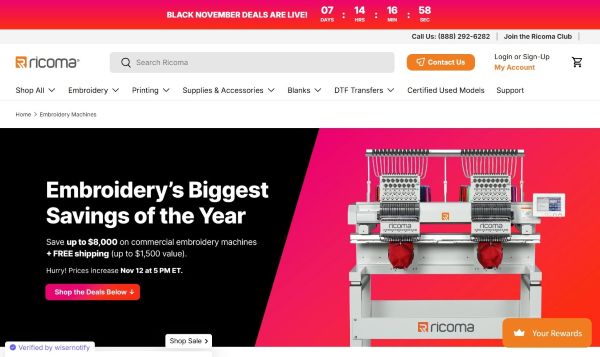
Source: Ricoma International Official Website https://ricoma.com/collections/embroidery-machines
Ricoma offers embroidery machines for users who want to produce custom apparel, personalized products, and in-house embroidery work. Its EM-1010 model is a 10-needle embroidery machine designed for users who want professional-quality embroidery in an approachable setup, with features aimed at beginners, creators, and small business users.
For buyers comparing Ricoma with Tajima, Ricoma is often easier to evaluate from a setup-and-growth perspective: what machine can help the business start, learn, and gradually handle more embroidery orders?
Source: Ricoma Official Website https://ricoma.com/
Tajima

Source: Tajima Official Website(https://www.tajima.com/product/)
Tajima is a Japan-based embroidery machine manufacturer with a long history in automatic embroidery machines. Its history includes the launch of TAJIMA multi-head automatic embroidery machines in 1964, which helps explain why the brand is often associated with professional embroidery production.
The TMEZ-SC is Tajima’s single-head cylinder type flagship model, designed for applications such as name embroidery, emblem processing, uniforms, hats, socks, bags, and in-store embroidery work.
Source: Tajima Official Website https://www.tajima.com/
How Ricoma and Tajima Product Lines Compare
The Ricoma EM-1010 and Tajima TMEZ-SC both point toward single-head embroidery use, but they are built around different buyer expectations.
Ricoma EM-1010
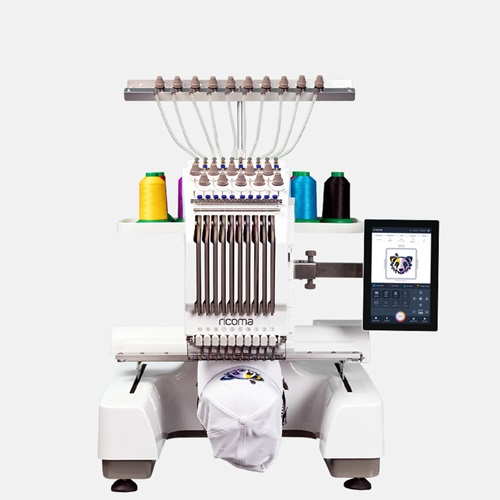
Source: Ricoma International Official Website (https://ricoma.com/products/10-needle-easy-to-use-embroidery-machine-for-beginners-with-10-1-touchscreen-panel)
Ricoma offers the EM-1010 as a 10-needle embroidery machine for users who want professional-quality embroidery at home or in a small business setting. It is designed for hats, shirts, jackets, bags, and other personalized items, with features such as up to 1,000 stitches per minute, a 12.2" × 8.3" embroidery area, and a 10.1" touchscreen panel.
Specifications of EM-1010
| Specification | Ricoma EM-1010 |
|---|---|
| Maximum Speed | 1,000 stitches/min |
| Number of Heads | 1 |
| Number of Needles | 10 needles |
| Maximum Embroidery Field | 310 × 210 mm |
| Weight | Approx. 45 kg |
| Power Consumption | Not specified on the official website |
Source: Ricoma Official Website https://ricoma.com/
Tajima TMEZ-SC
Tajima offers the TMEZ-SC as a single-head cylinder type flagship model equipped with Tajima’s advanced embroidery technologies. It is suited for name embroidery and emblem processing on uniforms, hats, socks, bags, and similar items, as well as in-store embroidery processing.

Image source: Tajima Official Website https://www.tajima.com/product/tmez-sc/
The Tajima TMEZ-SC is a useful reference point for buyers who need stable quality, material flexibility, and operator support in a professional embroidery workflow. Tajima’s i-TM and DCP technologies are positioned to help even embroidery beginners work on different materials at high speed while maintaining stable quality.
Specifications of TMEZ-SC
| Specification | Tajima TMEZ-SC |
|---|---|
| Maximum Speed | 1,200 rpm maintains maximum speed for stitch lengths up to 4 mm |
| Number of Heads | 1 single-head |
| Number of Needles | 9, 12, or 15 needles |
| Maximum Embroidery Field | 360 × 500 mm / 14.1 inches × 19.6 inches |
| Weight | Approx. 95 kg |
| Power Consumption | Approx. 160 W |
Source: Tajima Official Website https://www.tajima.com/
What the Product Line Difference Means
Ricoma EM-1010 is best framed as an approachable 10-needle option for buyers who want to start or expand custom embroidery with training, touchscreen operation, and a manageable setup.
Tajima TMEZ-SC is better framed as a professional single-head machine for shops that need stable stitch quality, advanced thread and presser-foot control, and smoother operation across different finished products.
For both brands, the right model depends on day-to-day use: what products the business embroiders, who operates the machine, how often orders come in, and how much support is needed after purchase.
Workflow, Production Volume, and Business Scale
The right embroidery machine depends on more than the number of needles or the brand name. Buyers also need to think about who will operate the machine, what products they will embroider, and how often orders need to be produced.
For Small Shops and Custom Product Businesses
Ricoma EM-1010 may fit businesses that want to handle varied custom orders without starting with a larger production setup. Its 10-needle configuration, touchscreen panel, cap system, and training support make it relevant for personalized apparel, hats, bags, uniforms, and small-batch embroidery work.
This direction is especially useful when a business is still learning its order patterns, testing product categories, or adding embroidery as a new in-house service.
Source: Ricoma Official Website https://ricoma.com/
For In-Store Embroidery and Professional Workflow
Tajima TMEZ-SC may fit businesses that need a single-head machine for professional embroidery work where stable output and operator support are important. It is suited for name embroidery, emblem processing, uniforms, hats, socks, bags, and in-store embroidery processing.
The i-TM and DCP technologies are especially relevant when a business wants to reduce operator dependency and maintain stable quality across different materials, including situations where the operator has limited embroidery experience.
Source: Tajima Official Website https://www.tajima.com/
How Production Needs Change the Comparison
For low to moderate order volumes and a wide mix of custom items, the Ricoma EM-1010 is better framed as a flexible starting point. For shops that need more controlled output across different materials or recurring in-store embroidery work, the Tajima TMEZ-SC should be reviewed from a workflow perspective.
Before choosing, buyers should define their monthly order volume, most common product types, operator experience, available workspace, and expected growth over the next few years.
Which Brand Fits Your Business?
The best choice depends on how the machine will be used after installation. Instead of choosing by brand name alone, compare Ricoma and Tajima by business stage, product mix, operator experience, and production expectations.
When Ricoma EM-1010 May Fit Better
Ricoma EM-1010 may fit buyers who want to start or expand embroidery work with a machine that feels approachable, flexible, and supported by training. It is especially relevant for custom apparel shops, home-based businesses, personalization services, and small teams handling varied products such as hats, shirts, jackets, bags, and uniforms.
This direction makes sense when the business needs room to learn, test different products, and grow into more consistent embroidery orders without starting from a larger production setup.
When Tajima TMEZ-SC May Fit Better
Tajima TMEZ-SC may fit buyers who need a single-head machine for professional embroidery work where stable quality, material flexibility, and operator support matter. It is especially relevant for in-store embroidery, name embroidery, emblem processing, uniforms, hats, socks, bags, and recurring commercial jobs.
This direction makes sense when the business wants to reduce operator dependency, handle different materials with more control, and keep embroidery quality stable across repeated work.
Questions to Ask Before Choosing
- Will the machine be used for custom one-off items or repeat commercial orders?
- Will the operator be a beginner, an experienced embroiderer, or a rotating staff member?
- Are the main products hats, garments, bags, uniforms, socks, or a mix of several categories?
- Is the business choosing its first commercial embroidery machine, or upgrading an existing workflow?
In conclusion, Ricoma EM-1010 may be the more practical option to evaluate when the goal is to start or expand flexible custom embroidery from a manageable setup.
Tajima TMEZ-SC may be the stronger comparison point when the goal is to support professional in-store embroidery or recurring custom work with more stable quality control and operator support.
Find the Right Commercial Embroidery Machine
for Your Business Type
for Your Business Type
Ricoma and Tajima take different approaches to commercial embroidery, but the right choice ultimately depends on how your business produces, what products you embroider, and how much capacity you need.
This website helps you compare commercial embroidery machines by business type, from custom apparel shops and in-store embroidery services to higher-volume production environments.
Frequently Asked Questions
Q: Is Ricoma or Tajima better for beginners?
A: Ricoma EM-1010 may be easier to evaluate for beginners who want an approachable embroidery setup with touchscreen operation, 10-needle capability, and lifetime training and support.. Tajima TMEZ-SC also supports beginner operators through technologies such as i-TM and DCP, which are designed to help users work on different materials with stable quality.
Q: Which is better for in-store embroidery?
A: Tajima TMEZ-SC is positioned for in-store embroidery processing, as well as name embroidery and emblem processing on uniforms, hats, bags, and other items. Ricoma EM-1010 can also be considered for shops handling hats, shirts, jackets, bags, uniforms, and personalized products, especially when flexibility and training support are important.
Q: Should I compare embroidery machine brands or specific models first?
A: Start with the brand direction, then compare specific models. Brand comparison helps clarify whether the buyer needs flexible custom embroidery, in-store service, recurring production, operator support, or long-term workflow stability. After that, model-level comparison should focus on needle count, embroidery area, speed, cap support, software workflow, training, warranty, and service access.
Q: What should buyers check before choosing between Ricoma and Tajima?
A: Buyers should compare product types, expected order volume, operator experience, available workspace, training needs, warranty, service access, and future growth plans. The right choice depends less on the brand name alone and more on how the machine will be used every day.

[Advertisement]
3 Recommended Embroidery MachinesSelected by Application
3 Recommended Embroidery MachinesSelected by Application
Advertiser Disclosure:
We receive compensation from some of the companies listed below.
This compensation may affect which companies are included and the order in which they appear.
ForOEM Businesses
For High-Mix, Small-Lot Production of Uniforms, Caps, and More
TMEZ Series(Tajima)

Source: Tajima Industries Official Website (https://www.tajima.com/product/tmez-sc/)

Source: Tajima Official Website (https://www.tajima.com/product/tmez-sc/)

Source: Tajima Official Website (https://www.tajima.com/product/frame/)

Source: Tajima Official Website (https://www.tajima.com/solution/personalization/)
Reasons for Recommendation
- Professional Embroidery,
Made Fast for Everyone
Tajima’s proprietary AI technology automatically adjusts embroidery settings according to fabric thickness and material.
Even without specialized skills, users can achieve stable, high-quality results.
By eliminating time-consuming trial stitching and manual adjustments, the system allows you to respond quickly to urgent orders with both speed and consistent quality.
Main specifications
- Needle Count: 9 / 12 / 15
- Number of Heads: 1 / 2 / 4 / 6 / 8
- Embroidery Field:
(Single-head TMEZ-SC)14.1inches× 19.6inches
(Multi-head TMEZ-KC)17.7inches× 19.6inches
View More
- Tajima’s proprietary AI technology automatically adjusts upper thread tension
- Automatic presser control adapts to changes in fabric thickness
- Cloud-based service supports efficient embroidery production workflows
For questions about the TMEZ Series, contact Tajima using its online inquiry form.
ForCostume Production Studios
For One-of-a-Kind Items such as Dresses and Stage Costumes
SPRINT Series(ZSK)

Source: ZSK Official Website (https://www.zsk.de/en/embroidery-machines/sprint/sprint6.php)

Source: ZSK Official Website (https://www.zsk.de/en/embroidery-machines/sprint.php)

Source: ZSK Official Website (https://www.zsk.de/en/embroidery-machines/sprint.php)

Source: ZSK Official Website https://www.zsk.de/en/embroidery-machines/sprint.php)
Reasons for Recommendation
- Unlocking Creative Potential
with Versatile All-in-One Processing
The SPRINT Series enables diverse decoration—including sequins, beads, and cording—on a single machine. Its 7XL model features a massive 600 x 400 mm area, allowing large, seamless patterns on dresses or costumes in one pass. This eliminates frame repositioning, ensuring precise, flawless embroidery for delicate designs.
Main specifications
- Needle Count: 12 / 18
- Number of Heads: 1 (single-head)
- Embroidery Field:
Max. 24 inches x 16 inches
View More
- Embroiders on a large area of up to 24 inches x 16 inches
- Automatic thread break detection
- Built-in memory for approximately 80 million stitches
For further details, please visit the official website
ForCustom embroidery shops
For Handmade Original Goods and More
EM-1010(Ricoma)

Source: Ricoma Official Website (https://info.ricoma.com/embroidery/em-1010/g)

Source: Ricoma Official Website (https://info.ricoma.com/embroidery/em-1010/g)

Source: Ricoma Official Website (https://info.ricoma.com/embroidery/em-1010/g)

Source: Ricoma Official Website (https://info.ricoma.com/embroidery/em-1010/g)
Reasons for Recommendation
- Ready for Embroidery on the Day It Arrives, No Preparation Necessary
EThe affordable $8,995 EM-1010 includes a full starter kit, allowing you to begin production immediately. Its 7-inch touchscreen simplifies design creation and repeat orders, boosting efficiency. With no extra accessories needed, it’s a ready-to-use solution for scaling your business and handling sudden order surges.
Main specifications
- Needle Count: 10
- Number of Heads: 1 (single-head)
- Embroidery Field:
14 x 20 inches
View More
- No thread changes required for multi-color designs
- Data can be transferred via USB
- Easy-to-use touchscreen
For further details, please visit the official website
Source for *1 and *2: Tajima Official Website (https://www.tajima.com/product/tmez-kc/)