Commercial Embroidery Machines Guide » Commercial Embroidery Machine Comparison Guide » Ricoma Swift 2 vs MAYA DT-1501
Ricoma Swift 2 vs MAYA DT-1501
Index
More
The Ricoma Swift 2 and TOPMAYA DT-1501 overlap in the areas that define a commercial single-head embroidery machine: both are available with 15 needles, support cap and flat embroidery, use a touchscreen control panel, and provide network-based design transfer. Their differences become more significant when production speed, embroidery-field orientation, operator assistance, specialty attachments, and after-sales support enter the decision.
Prioritize the Swift 2 when published speed, thread-break monitoring, a slim sewing arm, and a documented US support package match your workflow. Examine the DT-1501 when you need a 12- or 15-needle configuration, laser positioning, a broad voltage range, or optional equipment for specialty embroidery. In either case, confirm the conflicting embroidery-area figures and test the machine with representative products before ordering.
Sources: Ricoma Swift 2 official product page; TOPMAYA DT-1501 official product page
(https://ricoma.com/products/swift-2-commercial-15-needle-high-speed-embroidery-machine)
(https://www.topmayagroup.com/single-head-emboridery-machine/dt-1501-single-head-embroidery.html)
(https://ricoma.com/products/swift-2-commercial-15-needle-high-speed-embroidery-machine)
(https://www.topmayagroup.com/single-head-emboridery-machine/dt-1501-single-head-embroidery.html)
Key Takeaways
- The Swift 2 has the higher published flat-embroidery speed at 1,350 stitches per minute; the DT-1501 lists 1,200 spm for flat embroidery and 1,000 spm for caps.
- The machines provide differently shaped work areas. Published figures indicate greater horizontal width for the Swift 2 and greater front-to-back depth for the DT-1501, but both manufacturers publish inconsistent dimensions that require confirmation.
- Ricoma documents more built-in operator-assistance features, including magnetic-encoder thread-break detection, automatic thread clamping, per-needle RGB lighting, and an ultra-slim sewing arm.
- Compare complete regional proposals rather than machine prices alone. Frames, software, training, warranty coverage, installation, local technicians, and replacement-parts availability can change the ownership decision.
Ricoma Swift 2 vs TOPMAYA DT-1501 at a Glance
| Comparison point | Ricoma Swift 2 | TOPMAYA DT-1501 |
|---|---|---|
| Needle configuration | 15 needles | 12 or 15 needles; this comparison uses the 15-needle version |
| Maximum listed speed | 1,350 spm | Flat: 1,200 spm; cap: 1,000 spm |
| Embroidery area | Official page lists both 22 × 14.5 in and 22 × 14.9 in | Product page: 500 × 400 mm, or 19.7 × 15.7 in; category page lists 400 × 450 mm |
| Cap rotation | 270° | 270° |
| Control panel | 10.1-inch HD true-color touchscreen | 10.1-inch HD true-color LCD touchscreen |
| Design memory | 100 million stitches or 1,000 designs | 100 million stitches or 800 designs |
| Connectivity | USB, Ethernet, and Wi-Fi | USB, LAN, and Wi-Fi |
| Positioning or visibility tools | Per-needle RGB lighting and quick-access controls | Laser pointer and LED lighting |
| Thread-related features | Magnetic-encoder thread-break detection and automatic thread clamping | Automatic trimming and color changes; closed-loop system mentioned without detailed operating specifications |
| Published net weight | 310 lb, or approximately 141 kg | 185 kg, or approximately 408 lb |
| Published warranty | One-year option or an optional five-year coverage package, depending on purchase configuration | One year |
Published maximum speeds do not represent guaranteed production rates. Design density, stitch length, trimming, color changes, framing, cap construction, thread, backing, and operator intervention all affect completed pieces per hour.
The manufacturers also publish inconsistent embroidery-area figures. Obtain a current specification sheet that identifies the applicable frame and usable X/Y sewing field before comparing design compatibility.
Sources: Ricoma Swift 2 official specifications; TOPMAYA single-head machine comparison and DT-1501 specifications
(https://ricoma.com/products/swift-2-commercial-15-needle-high-speed-embroidery-machine)
(https://www.topmayagroup.com/single-head-emboridery-machine/)
(https://www.topmayagroup.com/single-head-emboridery-machine/dt-1501-single-head-embroidery.html)
(https://ricoma.com/products/swift-2-commercial-15-needle-high-speed-embroidery-machine)
(https://www.topmayagroup.com/single-head-emboridery-machine/)
(https://www.topmayagroup.com/single-head-emboridery-machine/dt-1501-single-head-embroidery.html)
How the Two Machines Approach Commercial Embroidery
Ricoma Swift 2
引用元:Ricoma Youtube Channel
(https://www.youtube.com/watch?v=AL0VhVvsqsM)
(https://www.youtube.com/watch?v=AL0VhVvsqsM)
The Swift 2 combines a 15-needle head with a published maximum speed of 1,350 spm and a wide embroidery field. Ricoma equips the machine with a magnetic encoder that monitors thread movement for break detection, automatic thread clamping, quick-access buttons, and RGB lighting that identifies thread assignments at each needle.
An ultra-slim sewing arm provides access to openings such as pockets and sleeves. Ricoma also lists a sash frame and table for large designs or multiple patches, while the cap system provides 270-degree rotation. The US product page lists 11 hoops, two cap rings, a cap driver, a hooping station, and one sash frame, although bundle contents can change.
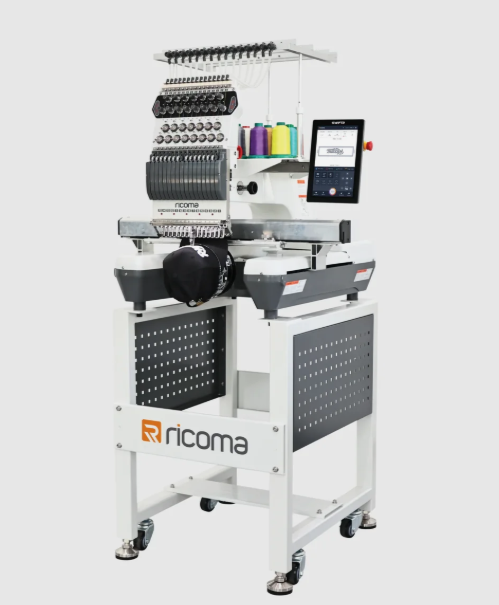
*Image source: Ricoma official website (https://ricoma.com/products/swift-2-commercial-15-needle-high-speed-embroidery-machine?variant=43472100753526)
MAYA DT-1501
引用元:MAYA official website
(https://www.topmayagroup.com/single-head-emboridery-machine/mt-1501-single-head-embroidery-machine.html)
(https://www.topmayagroup.com/single-head-emboridery-machine/mt-1501-single-head-embroidery-machine.html)
The DT-1501 is available with 12 or 15 needles and lists separate maximum speeds for flat and cap embroidery. Its 270-degree cap system, laser pointer, automatic color change, automatic trimming, and touchscreen controls cover the main operations required for caps, garments, flat goods, and 3D puff embroidery.
Maya lists a servo motor, a Hirose rotary hook, and a closed-loop system. The official page does not explain what the closed-loop system monitors or how it responds during sewing, so buyers should request a technical description rather than treating it as equivalent to Ricoma’s documented thread-break system.
The DT-1501 also supports USB, Wi-Fi, and LAN transfers. Its listed voltage range of 110–230V is broader than the 110V specification shown on Ricoma’s US page, but the correct electrical configuration must still be confirmed for the installation country.
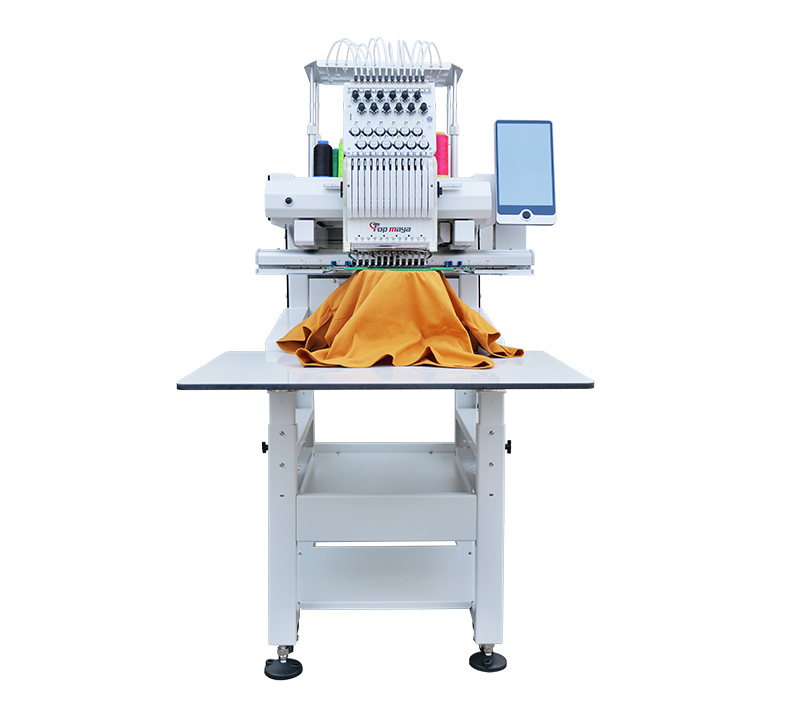
*Image source: MAYA official website (https://www.topmayagroup.com/single-head-emboridery-machine/dt-1501-single-head-embroidery.html)
Sources: Ricoma Swift 2 feature descriptions; TOPMAYA DT-1501 product specifications and feature descriptions
(https://ricoma.com/products/swift-2-commercial-15-needle-high-speed-embroidery-machine)
(https://www.topmayagroup.com/single-head-emboridery-machine/dt-1501-single-head-embroidery.html)
(https://ricoma.com/products/swift-2-commercial-15-needle-high-speed-embroidery-machine)
(https://www.topmayagroup.com/single-head-emboridery-machine/dt-1501-single-head-embroidery.html)
What the Swift 2 and DT-1501 Have in Common
Both machines can be configured as single-head, 15-needle systems for multicolor commercial embroidery. Each provides a 10.1-inch-class touchscreen, 270-degree cap rotation, automatic trimming and color changes, large design memory, and USB, Wi-Fi, and wired-network connectivity.
Their published applications include caps, garments, flat items, bags, and 3D embroidery. Both can also use frames or attachments for products that are difficult to hoop conventionally. Actual access, sewing area, and setup time depend on the selected frame and product construction.
These common specifications make the machines comparable, but they do not establish equivalent stitch quality, reliability, or output. The manufacturers do not publish directly comparable test results for those measures.
Sources: Ricoma Swift 2 official specifications; TOPMAYA DT-1501 official specifications
(https://ricoma.com/products/swift-2-commercial-15-needle-high-speed-embroidery-machine)
(https://www.topmayagroup.com/single-head-emboridery-machine/dt-1501-single-head-embroidery.html)
(https://ricoma.com/products/swift-2-commercial-15-needle-high-speed-embroidery-machine)
(https://www.topmayagroup.com/single-head-emboridery-machine/dt-1501-single-head-embroidery.html)
Key Differences Between the Swift 2 and DT-1501
Maximum Speed and Real Production Throughput
The Swift 2’s published maximum of 1,350 spm is 150 spm higher than the DT-1501’s listed flat-embroidery maximum. That difference is meaningful only when a design can run close to maximum speed without frequent trims, short stitches, material-related reductions, or operator stops.
Maya separately limits the published cap speed to 1,000 spm. Ricoma’s reviewed page does not state a separate maximum for caps, so the Swift 2’s 1,350-spm headline should not be assumed to apply to cap production. Run the same digitized cap design on both machines and record total cycle time, not only the speed displayed during long stitch segments.
Embroidery Area, Orientation, and Machine Footprint
Ricoma publishes a field approximately 22 inches wide and either 14.5 or 14.9 inches deep. Maya’s DT-1501 product page lists 19.7 × 15.7 inches. Based on those figures, the Swift 2 provides more horizontal width, while the DT-1501 provides more front-to-back depth.
That difference affects design orientation. A wide jacket-back graphic or a row of patches can benefit from horizontal travel, whereas a taller design can require more depth. Compare the actual design dimensions with the usable field of the included frame rather than rotating every design to fit.
Published machine dimensions are not necessarily measured under identical conditions. Request installation drawings that show the stand, table, cap driver, operating clearance, and service access before planning floor space.
Caps, Sleeves, Pockets, and Finished Products
Both machines list 270-degree cap rotation, but cap capability also depends on the driver, frame geometry, sewing-arm clearance, cap construction, and digitizing. The DT-1501 publishes a cap speed of up to 1,000 spm and uses a laser pointer to assist placement.
The Swift 2 uses an ultra-slim sewing arm for narrower openings and promotes closer access to the cap brim. Its included cap-equipment list is more detailed on the reviewed US page. Test structured caps, low-profile caps, side placements, and 3D puff designs because a rotation specification alone does not show how consistently a particular cap can be framed and sewn.
Thread Monitoring and Operator Intervention
Ricoma describes a magnetic encoder that monitors thread movement in real time and detects breaks. Automatic thread clamping holds and releases the thread at the start of sewing, while RGB needle lights show thread assignments. These features target detection, startup cleanliness, and operator visibility.
Maya documents automatic trimming, automatic color change, and a closed-loop system, but the product page provides limited technical detail about thread-break detection or automatic recovery. Ask the supplier to demonstrate a thread break, show the machine’s alert and restart process, and explain whether the system detects upper-thread and bobbin-related problems.
Design Storage and File Transfer
Both machines list memory for 100 million stitches. The Swift 2 stores up to 1,000 designs, compared with 800 for the DT-1501. Storage capacity is unlikely to be decisive for a shop that manages production files on a network, but it affects how many jobs can remain available directly at the machine.
Both provide USB, Wi-Fi, and wired-network connections. Ricoma specifies DST compatibility; the reviewed DT-1501 page does not identify supported embroidery formats. Confirm native and imported formats, file-size limits, design preview functions, editing controls, network security requirements, and whether software licenses are included.
Included Equipment and Expansion Options
Ricoma’s US page lists hoops, cap equipment, a sash frame, a table, Chroma Inspire software, training, and support within its displayed package. Because Ricoma sells multiple bundles and optional accessories, buyers should verify the written order rather than relying on a general “included” statement.
Maya lists multiple round and rectangular frames, cap frames, a cap stand, a cap driver, a flat table, an aluminum frame, and a bobbin winder. It also identifies optional equipment for pockets, socks, shoes, bags, sequins, beads, and cording. Confirm which options must be installed at the factory and whether adding them changes delivery time, controls, warranty, or operator training.
Sources: Ricoma Swift 2 official specifications, features, and package information; TOPMAYA DT-1501 specifications, accessories, and optional equipment
(https://ricoma.com/products/swift-2-commercial-15-needle-high-speed-embroidery-machine)
(https://www.topmayagroup.com/single-head-emboridery-machine/dt-1501-single-head-embroidery.html)
(https://ricoma.com/products/swift-2-commercial-15-needle-high-speed-embroidery-machine)
(https://www.topmayagroup.com/single-head-emboridery-machine/dt-1501-single-head-embroidery.html)
Which Machine Fits Different Production Scenarios?
Mixed Apparel and Fast-Turnaround Orders
Prioritize the Swift 2 when orders change frequently and operators need visible thread assignments, explicit thread-break monitoring, quick controls, and the higher published flat speed. Measure whether those features reduce intervention with your normal mix of polos, jackets, hoodies, bags, and personalized garments.
Select the DT-1501 for further testing when its laser placement, 15-needle configuration, and regional quotation meet the same mixed-order requirements. Verify thread-break handling and local service response before relying on it for deadline-sensitive work.
Cap and 3D Puff Production
Both machines require a cap trial because neither the 270-degree figure nor maximum speed predicts placement near the brim, registration across panels, or performance on thick seams. Compare framing time, usable design height, side coverage, thread breaks, registration, and finished appearance.
The Swift 2 provides a slim-arm design and a detailed cap package. The DT-1501 publishes a 1,000-spm cap maximum and laser positioning. The trial should determine which difference matters more for the caps you actually sell.
Oversized Designs and Patch Production
Use the Swift 2’s additional published width for wide designs or patch layouts that exceed the DT-1501’s horizontal field. Use the DT-1501’s additional published depth when recurring designs need more front-to-back travel.
Confirm both work areas before committing production files because the official pages contain conflicting dimensions. Also check whether the maximum field requires a sash frame or table that changes setup time and floor-space requirements.
Specialty Embroidery and Product Expansion
Maya publishes a broader list of specialty options, including devices for sequins, beads, and cording, as well as frames for socks, shoes, bags, and pockets. Businesses planning these applications should request option-specific samples, pricing, installation requirements, and training.
Ricoma lists optional frames for pockets, sleeves, socks, belts, shoes, bags, and other hard-to-hoop items. Compare the exact accessory needed for each planned product; a general compatibility statement does not establish the usable field or production method.
Sources: Ricoma Swift 2 published applications and optional frames; TOPMAYA DT-1501 applications and optional accessories
(https://ricoma.com/products/swift-2-commercial-15-needle-high-speed-embroidery-machine)
(https://www.topmayagroup.com/single-head-emboridery-machine/dt-1501-single-head-embroidery.html)
(https://ricoma.com/products/swift-2-commercial-15-needle-high-speed-embroidery-machine)
(https://www.topmayagroup.com/single-head-emboridery-machine/dt-1501-single-head-embroidery.html)
What to Confirm Before Buying
Test the Machines with Representative Jobs
Provide both suppliers with the same production files, thread, backing, and product types. Include at least one structured cap, one dense multicolor logo, one stretch garment, one thick item, and one design near the required maximum field.
Record framing time, setup time, complete cycle time, trimming, thread breaks, restart accuracy, registration, and operator intervention. Use the highest speed that produces an acceptable result consistently rather than requiring both machines to run at their published maximum.
Compare Complete Equipment Packages
Request itemized proposals that identify the machine configuration, frames, cap system, stand, table, software, licenses, training, freight, assembly, installation, and optional devices. Confirm whether the DT-1501 quotation covers the 15-needle version rather than the 12-needle version.
Ricoma publishes online US pricing, while Maya directs buyers to request a quotation. Currency, taxes, import costs, delivery, service coverage, and bundle contents prevent a reliable price comparison until both proposals cover the same requirements.
Verify Warranty and Local Support
Ask who performs installation, training, maintenance, and warranty repairs in the machine’s operating region. Confirm technician location, response process, remote-support hours, spare-parts inventory, expected parts lead times, and responsibility for travel or shipping costs.
Obtain the complete warranty terms. Ricoma displays one-year and optional five-year coverage structures on its US page, while Maya lists a one-year warranty. Coverage duration alone does not show which electronics, drive components, labor, travel, consumables, or shipping costs are included.
Confirm Site and Purchasing Requirements
Verify the assembled dimensions, operating clearance, machine weight, doorway and elevator limits, unloading method, floor capacity, electrical supply, and network access. Do not assume that published dimensions include the same stand, table, or attachments.
Before issuing the order, confirm lead time, delivery terms, installation responsibilities, payment schedule, quote validity, and the process for adding machines or specialty devices later.
Sources: Ricoma Swift 2 package, warranty, support, and installation information; TOPMAYA DT-1501 specifications, warranty, accessories, and inquiry information
(https://ricoma.com/products/swift-2-commercial-15-needle-high-speed-embroidery-machine)
(https://www.topmayagroup.com/single-head-emboridery-machine/dt-1501-single-head-embroidery.html)
(https://ricoma.com/products/swift-2-commercial-15-needle-high-speed-embroidery-machine)
(https://www.topmayagroup.com/single-head-emboridery-machine/dt-1501-single-head-embroidery.html)
Ricoma Swift 2 or TOPMAYA DT-1501: Which Should You Choose?
Choose the Machine That Matches
Your Actual Production Workflow
Your Actual Production Workflow
Prioritize the Ricoma Swift 2 when the operation requires the higher published flat speed, a wider sewing field, a slim arm, documented thread-break monitoring, visible needle identification, and a defined Ricoma support package in the purchasing region.
Prioritize the 15-needle TOPMAYA DT-1501 when laser positioning, a deeper published field, 110–230V compatibility, factory-configurable specialty options, or the Maya quotation provides a concrete operational or commercial advantage.
Neither machine should be selected from headline specifications alone. Compare corrected specification sheets, complete proposals, local support arrangements, and results from the same test jobs. The machine that completes representative work with fewer interventions and a support package your business can use is the more defensible purchase.
Sources: Ricoma Swift 2 official product page; TOPMAYA DT-1501 official product page
(https://ricoma.com/products/swift-2-commercial-15-needle-high-speed-embroidery-machine)
(https://www.topmayagroup.com/single-head-emboridery-machine/dt-1501-single-head-embroidery.html)
(https://ricoma.com/products/swift-2-commercial-15-needle-high-speed-embroidery-machine)
(https://www.topmayagroup.com/single-head-emboridery-machine/dt-1501-single-head-embroidery.html)

3 Recommended Embroidery MachinesSelected by Application
ForOEM Businesses
For High-Mix, Small-Lot Production of Uniforms, Caps, and More
TMEZ Series(Tajima)

Source: Tajima Industries Official Website (https://www.tajima.com/product/tmez-sc/)

Source: Tajima Official Website (https://www.tajima.com/product/tmez-sc/)

Source: Tajima Official Website (https://www.tajima.com/product/frame/)

Source: Tajima Official Website (https://www.tajima.com/solution/personalization/)
Reasons for Recommendation
- Professional Embroidery,
Made Fast for Everyone
Tajima’s proprietary AI technology automatically adjusts embroidery settings according to fabric thickness and material.
Even without specialized skills, users can achieve stable, high-quality results.
By eliminating time-consuming trial stitching and manual adjustments, the system allows you to respond quickly to urgent orders with both speed and consistent quality.
Main specifications
- Needle Count: 9 / 12 / 15
- Number of Heads: 1 / 2 / 4 / 6 / 8
- Embroidery Field:
(Single-head TMEZ-SC)14.1inches× 19.6inches
(Multi-head TMEZ-KC)17.7inches× 19.6inches
View More
- Tajima’s proprietary AI technology automatically adjusts upper thread tension
- Automatic presser control adapts to changes in fabric thickness
- Cloud-based service supports efficient embroidery production workflows
For further details, please visit the official website
ForCostume Production Studios
For One-of-a-Kind Items such as Dresses and Stage Costumes
SPRINT Series(ZSK)

Source: ZSK Official Website (https://www.zsk.de/en/embroidery-machines/sprint/sprint6.php)

Source: ZSK Official Website (https://www.zsk.de/en/embroidery-machines/sprint.php)

Source: ZSK Official Website (https://www.zsk.de/en/embroidery-machines/sprint.php)

Source: ZSK Official Website https://www.zsk.de/en/embroidery-machines/sprint.php)
Reasons for Recommendation
- Unlocking Creative Potential
with Versatile All-in-One Processing
The SPRINT Series enables diverse decoration—including sequins, beads, and cording—on a single machine. Its 7XL model features a massive 600 x 400 mm area, allowing large, seamless patterns on dresses or costumes in one pass. This eliminates frame repositioning, ensuring precise, flawless embroidery for delicate designs.
Main specifications
- Needle Count: 12 / 18
- Number of Heads: 1 (single-head)
- Embroidery Field:
Max. 24 inches x 16 inches
View More
- Embroiders on a large area of up to 24 inches x 16 inches
- Automatic thread break detection
- Built-in memory for approximately 80 million stitches
For further details, please visit the official website
ForCustom embroidery shops
For Handmade Original Goods and More
EM-1010(Ricoma)

Source: Ricoma Official Website (https://info.ricoma.com/embroidery/em-1010/g)

Source: Ricoma Official Website (https://info.ricoma.com/embroidery/em-1010/g)

Source: Ricoma Official Website (https://info.ricoma.com/embroidery/em-1010/g)

Source: Ricoma Official Website (https://info.ricoma.com/embroidery/em-1010/g)
Reasons for Recommendation
- Ready for Embroidery on the Day It Arrives, No Preparation Necessary
EThe affordable $8,995 EM-1010 includes a full starter kit, allowing you to begin production immediately. Its 7-inch touchscreen simplifies design creation and repeat orders, boosting efficiency. With no extra accessories needed, it’s a ready-to-use solution for scaling your business and handling sudden order surges.
Main specifications
- Needle Count: 10
- Number of Heads: 1 (single-head)
- Embroidery Field:
14 x 20 inches
View More
- No thread changes required for multi-color designs
- Data can be transferred via USB
- Easy-to-use touchscreen
For further details, please visit the official website
Source for *1 and *2: Tajima Official Website (https://www.tajima.com/product/tmez-kc/)