Commercial Embroidery Machines Guide » Commercial Embroidery Machine Comparison Guide » Barudan Pro3 vs. Tajima TMEZ-SC
Barudan Pro3 vs. Tajima TMEZ-SC
Index
More
The Barudan Pro3 and Tajima TMEZ-SC are professional, single-head embroidery machines made for commercial production. Both can handle apparel, caps, bags, uniforms, and other finished goods, but they take different approaches to the work.
The right choice depends on what you embroider, who operates the machine, and how your production floor is organized.
Quick comparison
| Feature | Barudan Pro3 | Tajima TMEZ-SC |
|---|---|---|
| Machine type | Single-head, bridge-style commercial embroidery machine | Single-head cylinder-type commercial embroidery machine |
| Needles | 15 | 9, 12, or 15 |
| Maximum speed | 1,300 spm on flats; 1,000 spm on caps | 1,200 rpm maximum; up to 1,000 rpm on caps |
| Large embroidery field | 360 × 500 mm in Barudan's Pro3 brochure* | 360 × 500 mm with border frame |
| Thread management | Adjustable tensioner system | i-TM automatic upper-thread management |
| Material handling technology | Positive needle drive | i-TM and DCP |
| Control panel | 8.4-inch LCD touchscreen | 12.1-inch touchscreen |
| Machine weight | 96 kg / 211 lb | 95 kg / about 209 lb |
| Notable workflow features | MK8 trimmer, USB/LAN, Barudan networking support | Picker-free trimming, design-position correction, connected workflow options |
Barudan's brochure lists 15 needles, a 360 × 500 mm maximum sewing field, speeds of 1,300 spm on flats and 1,000 spm on caps, and a machine weight of 96 kg.
Tajima offers the TMEZ-SC in 9-, 12-, and 15-needle configurations. Its published specifications include a 360 × 500 mm border-frame field, a maximum speed of 1,200 rpm, and a machine weight of 95 kg.
*Barudan's current Pro3 webpage gives two different figures for the maximum sewing field. The product description says 360 × 500 mm, while the specifications section says 380 × 500 mm. The official Pro3 brochure used for this comparison lists 360 × 500 mm. Confirm the current specification with your dealer before ordering.
Source: Barudan Pro3 Official Product Page (https://www.barudanamerica.com/pro3/)
Source: Tajima TMEZ-SC Official Product Page (https://www.tajima.com/product/tmez-sc/)
1. Embroidery area and access to finished goods
The two machines offer nearly identical large-format capacity on paper. Barudan's Pro3 brochure lists a maximum sewing field of 360 × 500 mm, and Tajima lists a 360 × 500 mm border-frame field for the TMEZ-SC.
The bigger practical difference is how each machine gives the operator access to awkward embroidery locations.
Barudan's Pro3 has an open bridge-style chassis and a small-diameter cylinder arm. Barudan promotes this setup for larger finished items such as duffel bags, tote bags, and jacket backs, along with confined areas such as pockets, socks, and sleeves.
The TMEZ-SC also has a slim cylinder bed for tubular products. It works with border, tubular, cap, pocket, sock, and clamp frames. Tajima markets the machine for uniforms, hats, socks, bags, and in-store personalization.
If your shop handles a wide range of finished products, look beyond the maximum field size. The available frames and the machine's ability to reach the actual placement area may have a greater effect on daily production.
Source: Barudan Pro3 Official Product Page (https://www.barudanamerica.com/pro3/)
Source: Tajima TMEZ-SC Official Product Page (https://www.tajima.com/product/tmez-sc/)
2. Speed and production style
The Pro3 has the higher published maximum speed for flat embroidery: 1,300 stitches per minute, compared with the TMEZ-SC's maximum of 1,200 rpm. Both manufacturers list cap speeds of up to 1,000.
Maximum sewing speed is only part of the throughput calculation, though. Setup, trims, color changes, thread breaks, and operator adjustments all add time to a job.
Tajima says the TMEZ-SC can maintain its maximum RPM on stitches up to 4 mm and avoid excessive slowing across the 3–7 mm range. The company also emphasizes shorter setup times and less trial sewing.
In simple terms, the Pro3 has the higher published speed for flat goods. The TMEZ-SC is built to save time elsewhere by reducing setup and adjustment work.
Actual production time will still vary with the design, stitch length, material, thread, number of trims, color changes, and operator workflow.
Source: Barudan Pro3 Official Product Page (https://www.barudanamerica.com/pro3/)
Source: Tajima TMEZ-SC Official Product Page (https://www.tajima.com/product/tmez-sc/)
3. Thread and material control
Thread and material handling are where the machines differ most.
The Pro3 uses Barudan's updated tensioner system and positive needle drive. According to Barudan, the tensioner improves thread control and thread-break detection. The positive needle drive is intended to maintain stitch quality on demanding jobs, including thick karate belts and 3D foam embroidery on caps.
The TMEZ-SC combines i-TM with DCP. DCP measures fabric thickness as the machine sews, while i-TM adjusts the amount of upper thread supplied according to the material and stitch type. Tajima says this reduces the need for the upper-thread tension adjustments normally made by experienced operators.
The two systems are not direct equivalents. Barudan gives the operator a conventional tensioning system paired with controlled needle penetration. Tajima automates more of the thread supply and presser-foot response.
That distinction matters most in shops that move frequently between polos, caps, hoodies, bags, leather, foam, and other materials. A business running long batches of similar products may value the difference less than one handling short, varied orders throughout the day.
Source: Barudan Pro3 Official Product Page (https://www.barudanamerica.com/pro3/)
Source: Tajima TMEZ-SC Official Product Page (https://www.tajima.com/product/tmez-sc/)
4. Cap embroidery and specialty work
Both machines are built for commercial cap embroidery.
The Pro3 runs at up to 1,000 spm on caps. Barudan lists a maximum cap area of approximately 3 × 14 inches, depending on the cap, and its Advantage EX cap system allows tool-free switching between caps and flat goods.
Tajima lists a 75 × 360 mm (2.9 × 14.1 in.) wide cap frame and speeds of up to 1,000 rpm. Its cap system locks the drive ring and cap frame at three points. Tajima says this improves stability while helping to reduce needle breaks and design misalignment.
The published cap specifications are close, so a sample run will tell you more than the numbers. Test the machines with the structured caps, side placements, 3D puff designs, and hooping methods your shop uses. Pay attention to both stitch quality and changeover time.
Source: Barudan Pro3 Official Brochure (https://www.barudanamerica.com/wp-content/uploads/2018/11/PRO3-Flyer.pdf)
Source: Tajima TMEZ-SC Official Product Page (https://www.tajima.com/product/tmez-sc/)
5. Operator experience and workflow
The Pro3 has an 8.4-inch LCD touchscreen and can store up to 70 million stitches across 100 designs. Barudan's literature also lists USB ports, LAN connectivity, the MK8 trimmer, and support for the company's machine-networking system.
The TMEZ-SC has a larger 12.1-inch touchscreen. A design-position adjustment function lets operators correct some framing misalignment from the control panel. The machine also uses a picker-free thread-trimming system, which is intended to simplify bobbin replacement and improve trimming consistency.
Its main operator-focused advantage is still the combination of i-TM and DCP. By reducing manual upper-thread adjustments, the TMEZ-SC may be easier to manage in shops that change products often or have several operators with different experience levels.
Tajima also offers connected tools for design management, personalization, and production monitoring. The TMEZ-SC brochure identifies PulselQ as an optional cloud-based service for centralized design management, progress tracking, and machine-status monitoring.
Source: Barudan Pro3 Official Product Page (https://www.barudanamerica.com/pro3/)
Source: Tajima TMEZ-SC Official Product Page (https://www.tajima.com/product/tmez-sc/)
6. Choosing the right machine for your shop
| Consider the Barudan Pro3 if… | Consider the Tajima TMEZ-SC if… |
|---|---|
| High maximum speed on flat goods is a priority | You want to reduce manual thread adjustments |
| You produce caps, jackets, bags, uniforms, and specialty items | You change products and materials frequently |
| Your operators prefer direct control over thread setup | Several operators, including less-experienced staff, use the machine |
| You regularly embroider thick materials or use 3D foam | Automated thread and material adjustment would help your workflow |
| Barudan's cap system, service network, or other equipment suits your operation | Tajima's personalization and connected-production tools suit your operation |
Treat these as starting points, not fixed rules. An experienced operator may prefer the TMEZ-SC, while a first-time embroidery business may be more comfortable with the Pro3.
Dealer support can also outweigh a single specification. Training, accessories, software, local parts availability, and familiarity with an existing machine fleet all affect the long-term value of the purchase.
Find the Right Commercial Embroidery Machine
for Your Business
for Your Business
Choosing between the Barudan Pro3 and Tajima TMEZ-SC comes down to more than maximum speed or individual features. Your typical products, job variety, operator experience, setup requirements, and available dealer support can all affect which machine works best in daily production.
If you are still exploring your options, compare commercial embroidery machines by business type to find models that match the way your shop operates.
About Tajima TMEZ-SC
*Source: Tajima Youtube Channel (https://www.youtube.com/watch?v=PIG_KoUX3WM)
The Tajima TMEZ-SC is a single-head, cylinder-type commercial embroidery machine designed to automate adjustments that often depend on operator experience. It is available with 9, 12 or 15 needles and has a listed maximum speed of 1,200 rpm.
Its i-TM system controls upper-thread delivery, while the Digitally Controlled Presser Foot adjusts to changes in fabric thickness and stitch conditions. The machine can embroider uniforms, caps, socks, bags and other finished products, and its narrow cylinder bed provides access to sleeves, pockets and other tubular or hard-to-reach areas.

*Image source: Tajima Official Website (https://www.tajima.com/product/tmez-sc/)
Key Features of the Tajima TMEZ-SC
- Available with 9, 12 or 15 needles
- Listed maximum speed of 1,200 rpm
- 360 × 500 mm, or 14.1 × 19.6-inch, border-frame embroidery field
- i-TM automatic upper-thread delivery control
- Digitally Controlled Presser Foot that measures fabric thickness at every stitch
- 12.1-inch touchscreen operation panel
- On-screen design-position adjustment
- Compatible frames and attachments for caps, pockets, socks and tubular products
Source: Tajima TMEZ-SC official product page
(https://www.tajima.com/product/tmez-sc/)
(https://www.tajima.com/product/tmez-sc/)
About the Barudan Pro3
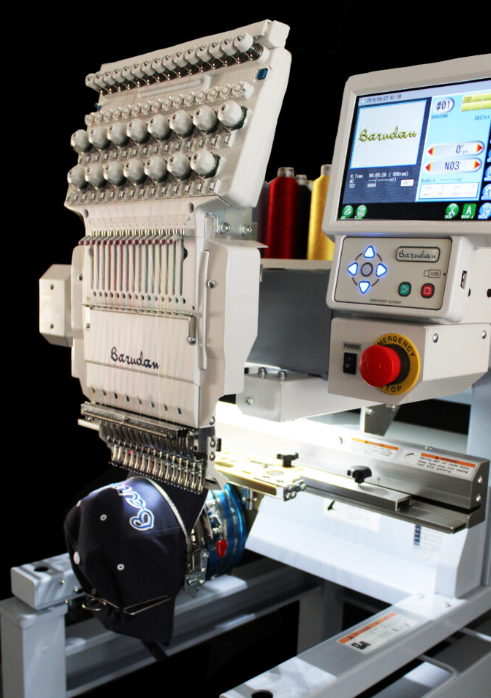
*Image source: Barudan Official Website (https://www.barudanamerica.com/pro3/)
The Barudan Pro3 (BEKT-S1501CBIII) is a 15-needle, single-head commercial embroidery machine designed to handle a wide range of finished products and larger items. Its open bridge-style chassis and 360 × 500 mm embroidery area provide room for products such as bags and jacket backs, while the smaller-diameter cylinder arm makes it possible to reach narrower areas such as pockets and slippers.
The Pro3 combines a listed maximum speed of 1,300 rpm for flat and finished-product embroidery with an 8.4-inch touchscreen, laser positioning and frame-management functions. It also supports cap embroidery at speeds of up to 1,000 rpm and can be used with dedicated frames for caps, pockets, socks and other finished products.
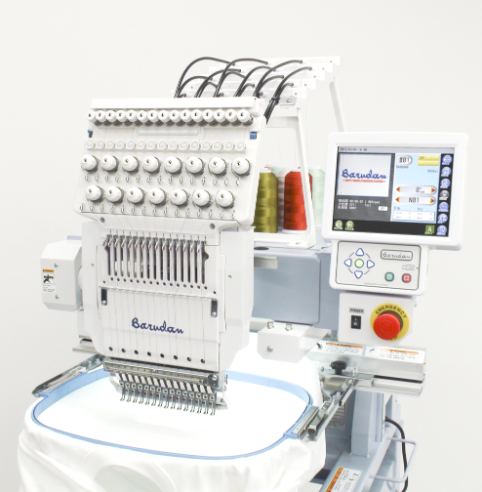
*Image source: Barudan Official Website (https://barudan.co.jp/post-product/product07/)
Key Features of the Barudan Pro3
- 15-needle single-head configuration
- 360 × 500 mm embroidery area
- Listed maximum speed of up to 1,300 rpm with flat and finished-product frames and up to 1,000 rpm with cap frames
- Open bridge-style chassis for working with larger items such as bags and jackets
- Smaller-diameter cylinder arm and redesigned trimmer for embroidery in narrow areas such as pockets
- 8.4-inch touchscreen LCD with memory for up to 100 designs
- Standard laser pointer plus frame-centering and frame-limit functions for design placement
- USB and LAN connectivity, with networking and additional design-transfer options available
Sources: Barudan BEKT-S1501CBIII official product page
(https://www.barudanamerica.com/pro3/)
(https://www.barudanamerica.com/pro3/)
The bottom line
Choose the Barudan Pro3 if you place more value on its higher published flat-goods speed, open bridge-style design, slim cylinder arm, positive needle drive, and established cap-production system.
Choose the Tajima TMEZ-SC if you want i-TM and DCP automation, a larger touchscreen, more operator assistance, and fewer manual adjustments when materials or operators change.
Neither machine is the best choice for every shop. The better machine is the one that can run your typical jobs consistently without unnecessary setup, intervention, or downtime.
Before buying, ask both dealers to run your production files on the materials you use. Compare:
- Stitch quality on your usual garments and caps
- Setup and changeover time
- Thread breaks and trimming results
- Performance on 3D foam and difficult materials
- Frame, accessory, software, and subscription costs
- Training, warranty coverage, parts availability, and local service response
A live test with your own designs will give you a much clearer answer than the maximum-speed figure on a specification sheet.
Frequently Asked Questions
Is the Barudan Pro3 faster than the Tajima TMEZ-SC?
The Pro3 has the higher published maximum speed for flat embroidery at 1,300 spm. The TMEZ-SC has a published maximum of 1,200 rpm. Both are rated for cap embroidery at up to 1,000.
Those figures do not guarantee faster job completion. Production speed also depends on the design, material, stitch length, trims, color changes, machine settings, and operator workflow.
Which machine requires fewer manual thread-tension adjustments?
The TMEZ-SC is specifically designed to reduce manual upper-thread adjustments. Its i-TM system controls upper-thread supply using information from DCP about the material thickness and stitch conditions.
The Pro3 uses Barudan's adjustable tensioner system instead, giving the operator more direct control over thread setup.
What should a business compare besides the purchase price?
Look at the complete operating cost. This includes frames and cap systems, software or cloud-service fees, installation, training, warranty terms, replacement parts, local technical support, and the operator time needed for setup and troubleshooting.
A machine with a lower purchase price may cost more to operate if it requires additional accessories, frequent adjustments, or longer production stops.
Source: Barudan Pro3 Official Product Page (https://www.barudanamerica.com/pro3/)
Source: Tajima TMEZ-SC Official Product Page (https://www.tajima.com/product/tmez-sc/)

[Advertisement]
3 Recommended Embroidery MachinesSelected by Application
3 Recommended Embroidery MachinesSelected by Application
Advertiser Disclosure:
We receive compensation from some of the companies listed below.
This compensation may affect which companies are included and the order in which they appear.
ForOEM Businesses
For High-Mix, Small-Lot Production of Uniforms, Caps, and More
TMEZ Series(Tajima)

Source: Tajima Industries Official Website (https://www.tajima.com/product/tmez-sc/)

Source: Tajima Official Website (https://www.tajima.com/product/tmez-sc/)

Source: Tajima Official Website (https://www.tajima.com/product/frame/)

Source: Tajima Official Website (https://www.tajima.com/solution/personalization/)
Reasons for Recommendation
- Professional Embroidery,
Made Fast for Everyone
Tajima’s proprietary AI technology automatically adjusts embroidery settings according to fabric thickness and material.
Even without specialized skills, users can achieve stable, high-quality results.
By eliminating time-consuming trial stitching and manual adjustments, the system allows you to respond quickly to urgent orders with both speed and consistent quality.
Main specifications
- Needle Count: 9 / 12 / 15
- Number of Heads: 1 / 2 / 4 / 6 / 8
- Embroidery Field:
(Single-head TMEZ-SC)14.1inches× 19.6inches
(Multi-head TMEZ-KC)17.7inches× 19.6inches
View More
- Tajima’s proprietary AI technology automatically adjusts upper thread tension
- Automatic presser control adapts to changes in fabric thickness
- Cloud-based service supports efficient embroidery production workflows
For questions about the TMEZ Series, contact Tajima using its online inquiry form.
ForCostume Production Studios
For One-of-a-Kind Items such as Dresses and Stage Costumes
SPRINT Series(ZSK)

Source: ZSK Official Website (https://www.zsk.de/en/embroidery-machines/sprint/sprint6.php)

Source: ZSK Official Website (https://www.zsk.de/en/embroidery-machines/sprint.php)

Source: ZSK Official Website (https://www.zsk.de/en/embroidery-machines/sprint.php)

Source: ZSK Official Website https://www.zsk.de/en/embroidery-machines/sprint.php)
Reasons for Recommendation
- Unlocking Creative Potential
with Versatile All-in-One Processing
The SPRINT Series enables diverse decoration—including sequins, beads, and cording—on a single machine. Its 7XL model features a massive 600 x 400 mm area, allowing large, seamless patterns on dresses or costumes in one pass. This eliminates frame repositioning, ensuring precise, flawless embroidery for delicate designs.
Main specifications
- Needle Count: 12 / 18
- Number of Heads: 1 (single-head)
- Embroidery Field:
Max. 24 inches x 16 inches
View More
- Embroiders on a large area of up to 24 inches x 16 inches
- Automatic thread break detection
- Built-in memory for approximately 80 million stitches
For further details, please visit the official website
ForCustom embroidery shops
For Handmade Original Goods and More
EM-1010(Ricoma)

Source: Ricoma Official Website (https://info.ricoma.com/embroidery/em-1010/g)

Source: Ricoma Official Website (https://info.ricoma.com/embroidery/em-1010/g)

Source: Ricoma Official Website (https://info.ricoma.com/embroidery/em-1010/g)

Source: Ricoma Official Website (https://info.ricoma.com/embroidery/em-1010/g)
Reasons for Recommendation
- Ready for Embroidery on the Day It Arrives, No Preparation Necessary
EThe affordable $8,995 EM-1010 includes a full starter kit, allowing you to begin production immediately. Its 7-inch touchscreen simplifies design creation and repeat orders, boosting efficiency. With no extra accessories needed, it’s a ready-to-use solution for scaling your business and handling sudden order surges.
Main specifications
- Needle Count: 10
- Number of Heads: 1 (single-head)
- Embroidery Field:
14 x 20 inches
View More
- No thread changes required for multi-color designs
- Data can be transferred via USB
- Easy-to-use touchscreen
For further details, please visit the official website
Source for *1 and *2: Tajima Official Website (https://www.tajima.com/product/tmez-kc/)